Speculations on Near Death Experiences
In our normal every day experience, we rely on our senses to help us piece together our physical place in the world. If we see palm trees, feel the warm sun on our face, smell sea water and feel the soft sand between our toes, we recognize ourselves as being on a beach. But what would it be like if we didn't have the use of our senses? Is it possible to place ourselves in an environment without the use of any of the senses we rely on daily?
The answer is, in a way, yes. When we dream all of our senses have little to no utility in the experience we have. In a dream we can experience ourselves on a beach interacting with other beachgoers. We conjure up the surroundings in some unknown way. We can also do this with our imagination on demand. So it's possible to have an experience of being in an environment, interacting with "others" without the use of our senses at all.
Sleep Paralysis
In order to protect the dreamer from acting out their dreams, the brain essentially paralyzes the body while asleep. This protects the dreamer and those around him from getting hurt should the dreamer act out his role in the dream. When sleep paralysis occurs when arising in the morning, the dreamer may hallucinate. This is called Hypnopompic Hallucinations. According to an entry in Wikipedia an example is provided:
"... the subjects attempt to breathe deeply and find themselves unable to do so, creating a sensation of resistance, which the threat-activated vigilance system interprets as an unearthly being sitting on their chest, threatening suffocation."
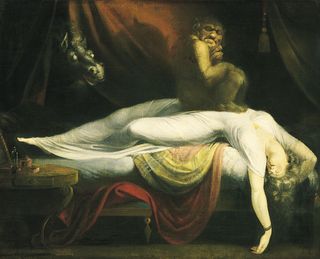
As the above shows a physical thing (the inability to breath more deeply most likely arising from sleep paralysis) leads to an affect on the content of the dream itself. In this case the belief that an evil entity is sitting on his chest trying to suffocate him.
Near death Experiences
To summarize above, the mind can very effectively build a narrative of the surroundings of the dreamer. And if some outside effect can "infiltrate" the dream it can thereby affect the narrative of the dream (as does sleep paralysis and hypnopompic hallucinations).
I believe this is what is happening in NDEs. If we were to start with the assumption that NDEs are true spiritual events, then it's fair to say that spiritual entities may interact with our consciousness. During an NDE, as the physical body is essentially useless and thus the senses have no effect on our conscious state, we build a narrative that is strongly influenced by whatever spiritual entities we are interacting with it. Just like the experience the mind creates of an entity on our chest preventing us from breathing (as we see with hypnopompic hallucinations), we build a narrative based on the interaction we are having with whatever spiritual entities we come across. Hence the appearance of Jesus, Buddha, etc, or a lush garden or castles, etc. Our mind creatively fills in the gaps to make sense of the environment it finds itself in but the overall story line is driven by the spiritual world in which the NDEr finds himself in.
Building a descriptive model of the world
We, through our senses allow us to interact with our world. We internalize what we see and build a library of experiences that allows us to make sense of it all. As we age our self awareness and our advanced understanding allows us to navigate the world more effectively. We learn to manage our emotions in the process, and build strong relationships with others. This is wisdom. In the spiritual world, we need to have this repertoire of experience to make sense of our "environment" as in this state, our interface with that environment is all mental. Think of the limitations that a deaf and blind person would experience who we will refer to as Helen going forward. Her mental functioning is normal except without the senses, she struggles to make any sense of the world she's in. When dead, Helen would interact with an environment and it would be experienced as strange and terrifying mental states. Let's take for example a very common element in NDES, the barrier which we are told we cannot cross. Some NDErs reach this point, and to make sense of the "barrier" they see it as a river, or a fence. They actually experience it this way. Its because of past experiences they can develop a symbolic representation of what they experience which although technically not an accurate representation of this barrier, the symbolic river or fence suffices to tell the person that it would not be possible to cross. How would Helen experience this same barrier? It's nearly impossible to say. How would Helen experience any interaction with others? It would all be mental states of some strange and limited way.

Comments
Post a Comment